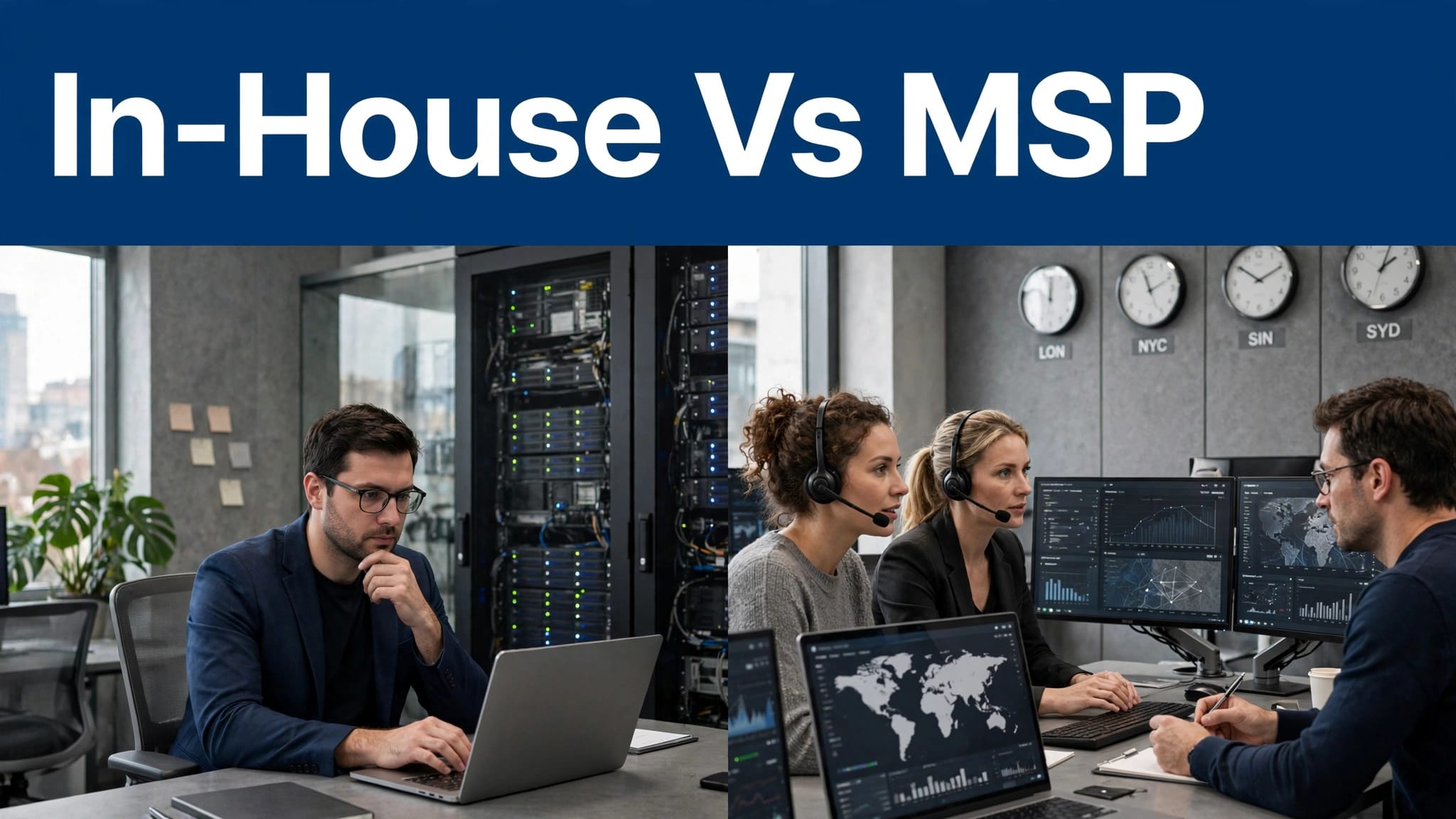
The right choice depends on geographic spread, IT infrastructure, cybersecurity and compliance requirements. It also depends on available expert knowledge, required scalability and whether 24/7 support is necessary.
An internal team can offer close business knowledge and fast on-site help. An outsourced provider can deliver broader expertise, technical support and flexible capacity across time zones. For many multinationals, a hybrid model provides the strongest balance.
Key Takeaways
- The right choice depends on geographic coverage, required expertise, cybersecurity and compliance needs, scalability and the level of support required.
- In-house IT provides greater control and business knowledge, but requires the organisation to fund recruitment, tooling, specialist skills and out-of-hours coverage.
- An MSP can provide broader expertise, flexible capacity and support across time zones, but requires strong supplier governance, clear responsibilities and careful security oversight.
- Compare both options using the same service scope and a complete total cost of ownership model, including transition costs, exclusions, tooling and the cost of failure.
- For many multinationals, a hybrid IT model offers the strongest balance by retaining strategic ownership internally while outsourcing defined operational or specialist services.
The decision in one sentence: control versus coverage
An internal IT team gives you direct control over systems, priorities and sensitive data. However, you carry the full cost of recruitment, salaries, training, tooling, management and out-of-hours cover.
An external managed service provider gives you access to a wider pool of skills without building every capability internally. The trade-off is supplier governance, clear responsibilities and a provider that understands your business operations.
The right model depends on four questions:
- How much scalability will each model provide as your locations and requirements change?
- Which services need clear ownership and detailed business knowledge?
- What IT support team does each country require for reliable local coverage?
- Which approach fits your organisation’s business culture and decision-making style?
A multinational may need international IT support for offices in several countries, while relying on internal staff at its headquarters for local knowledge. Another organisation may keep application ownership and its IT infrastructure in-house, while using external coverage for service desk support, endpoint management and security monitoring. IT management remains accountable for service outcomes in either model.
What an in-house global IT team really requires
An internal IT team often appears cheaper when the comparison only considers salaries against an MSP invoice. That approach misses the cost of providing coverage across locations, shifts and specialist disciplines.
Staffing across time zones and disciplines
A multinational operation faces a scalability challenge when covering multiple disciplines and locations. An IT support team may need service desk analysts, network engineers, cloud specialists, identity experts, security analysts, project managers and senior escalation staff. One person cannot provide dependable cover for every discipline and time zone.
Out-of-hours support adds further pressure. You may need an on-call rota, additional allowances, employment cover during holidays and contingency arrangements when a key employee leaves. Local offices may also need engineers who understand regional suppliers, connectivity and workplace systems.
Recruitment creates another constraint. Specialist security and cloud staff can be difficult to attract and retain, particularly outside major technology centres. A small internal team can also become dependent on one person who understands a particular platform.
The hidden total cost of ownership
The cost of internal IT includes more than payroll. A realistic model should test cost-effectiveness against the available IT budget, including:
- Recruitment fees, onboarding time and management overhead.
- Salaries, benefits, pension contributions and employer costs.
- Training, certifications, conferences and professional development.
- Monitoring, ticketing, backup, endpoint and security platforms.
- Hardware, test environments, licences, software management and replacement equipment.
- Hardware maintenance, on-call payments, overtime and temporary cover.
- Travel between sites and local technical contractors.
- Costs linked to turnover, delayed projects and unplanned incidents.
Internal teams can still provide strong value where IT infrastructure is unusual, operations are highly sensitive or local relationships matter. They also develop expert knowledge that an external provider must build over time.
What an outsourced MSP changes
A managed service provider (MSP) takes responsibility for agreed IT functions under a defined scope and service level. That scope may include help desk support, cloud services, endpoint management, backup, identity administration or security monitoring.
Scalability and access to expertise
An MSP can usually add outsourced IT capacity without requiring you to recruit a complete new team. That can help a business opening offices, acquiring another company or standardising its IT infrastructure across several countries.
The provider may also give you access to skills that would be expensive to maintain internally. Providers offer different commercial models, including subscription pricing, which may provide predictable costs without guaranteeing savings. A broad supplier market allows organisations to compare capabilities, coverage and commercial terms.
However, scale varies sharply between providers. Some MSPs offer genuine regional coverage. Others provide remote monitoring from one location and subcontract local work. Ask for evidence of staffing, escalation routes and support hours rather than assuming that “global” means worldwide IT support.
The NCSC guidance on choosing an MSP recommends examining how a provider operates, protects information and manages the relationship before signing a contract.
Context, responsiveness and supplier dependency
An MSP may resolve a standard access request quickly but take longer to understand a business-critical workflow. That risk is higher during onboarding, after an acquisition or when local teams use undocumented processes.
Contracts should define response time by priority, ownership of tools and data, escalation contacts, reporting standards and exit support. They should also explain what happens when the provider cannot resolve an issue remotely.
An external provider isn’t automatically more responsive than an internal team. Response time for technical support depends on staffing, queue management, service hours and the quality of the agreed operating model.
Cybersecurity and compliance need a separate comparison
Cybersecurity should not be judged by whether the team is internal or outsourced. Compare the controls, people, processes and evidence each model can sustain.
A small internal team may manage routine security tasks well but struggle to monitor alerts continuously. A larger managed service provider may operate dedicated analysts, threat detection tools and escalation processes. However, unclear privileged access or incident ownership could still create supplier risk and increase the impact of a data breach.
CISA warns that attackers may target MSPs because they can access multiple customers. Its advice on protecting MSPs and their customers supports a shared-responsibility approach.
For either model, test whether the cybersecurity controls cover your IT infrastructure and include:
- Centralised logging and alert triage.
- Vulnerability identification, network security and patch management.
- Multi-factor authentication and privileged access controls.
- Incident response procedures with named contacts.
- Regular access reviews and evidence for audits.
- Backup testing and disaster recovery planning to limit system downtime.
- Clear handling of personal, financial and regulated data.
Compliance remains the organisation’s responsibility, even when it outsources operational tasks. Your contract should specify where data is stored, who can access it, how incidents are reported and how evidence meets compliance requirements and supports auditors.
Build a more honest TCO comparison
A useful total cost of ownership comparison uses the same service scope on both sides. Don’t compare three employee salaries with an MSP’s monthly fee if it also supplies round-the-clock support, monitoring tools and specialist escalation. This baseline also gives finance a clearer IT budget.
Start by documenting the service baseline:
- Count users, devices, offices, applications and cloud platforms.
- Record current support volumes, severity levels and resolution times.
- List every internal role and the hours it covers.
- Add operational costs such as tooling, licences, training, contractors and on-call cover.
- Price the MSP scope, implementation work and contract management.
- Model growth, acquisitions and extra locations over three years.
Include transition costs in the first-year calculation. These may include discovery, documentation, tool deployment, access changes, knowledge transfer and parallel running. Compare subscription pricing as one commercial element, not as proof of value. Recurring fees may provide predictable costs, but exclusions and transition work still need to be modelled.
Also consider the cost of failure. System downtime, a delayed ransomware response or an unresolved access issue can affect revenue and compliance. Business continuity and disaster recovery belong in the financial model, even when these risks are difficult to price precisely.
A provider should explain what its fee excludes. Common exclusions include project work, after-hours changes, onsite travel, third-party licences, non-standard applications and support for undocumented systems.
Why a hybrid IT model often fits multinationals
A hybrid IT model keeps strategic ownership inside the organisation while assigning defined operational responsibilities to an MSP. This arrangement works well when the business needs local judgement but cannot justify every specialist capability in-house.
Keep business-critical decisions internal
IT management should usually own technology priorities, architecture decisions, risk acceptance and relationships with senior business leaders. It can also manage sensitive applications, local change requirements and communication with country managers, while ensuring decisions fit the organisation’s business culture.
This structure gives an internal team authority without requiring it to deliver every service around the clock. It can focus on business outcomes while an external partner provides 24/7 support for repeatable operational work.
Outsource difficult-to-staff capabilities
An outsourced IT partner can provide multi-country service delivery through an IT support team, covering help desk support, endpoint administration, cloud services, vulnerability management and cybersecurity monitoring. A specialist partner can also bring expert knowledge without replacing the internal technology lead.
For example, an organisation might retain two internal technology leads, outsource first-line support and use Managed SIEM Services for continuous security visibility. The arrangement only works when ownership is documented and the internal team can challenge the provider’s performance.
Hybrid does not mean splitting responsibility vaguely. Define one owner for each service, establish a single ticket route and agree who makes decisions during an incident.
A practical transition plan
Moving services to an MSP creates operational risk if the provider starts before it understands the environment. A controlled transition should protect business continuity while producing better documentation.
Discovery and pilot
Begin with an inventory of users, devices, locations, applications, network links, suppliers and privileged accounts across the IT infrastructure. Map dependencies, recurring incidents and unsupported systems.
Select one location or service for a pilot. Test ticket routing, escalation, reporting, remote access, remote monitoring and local support arrangements before expanding the scope. The pilot should protect business continuity and help prevent system downtime during wider migration. Set measurable acceptance criteria, such as response time, resolution quality and user feedback.
A security review can identify gaps before access is transferred. An IT Security Audit may also help establish a baseline for controls, permissions and exposed systems.
Migration and governance
Transfer knowledge in stages. Require runbooks, asset records, network diagrams, vendor contacts and application ownership details. Validate backups, disaster recovery dependencies and escalation procedures before handover. Keep internal staff involved during the early weeks so undocumented dependencies surface quickly.
Hold weekly service reviews during transition, with IT management reviewing incidents, changes, risks, projects and service levels. Then move to a regular governance meeting covering the same areas. Review the arrangement after 30, 60 and 90 days.
For international IT services, confirm regional support hours, language requirements, data locations and local escalation routes. Do not accept a service description that promises global technology support without explaining how coverage works in practice.
Questions to ask before choosing
Is an MSP more scalable than internal IT?
Often, yes, particularly when the business is growing or opening locations quickly. A managed service provider can add capacity and specialist support without a full recruitment cycle. This scalability depends on the provider’s staffing, technology stack and ability to support your countries and platforms.
Can an internal team provide 24/7 support?
Yes, but reliable 24/7 support usually requires enough staff for shifts, holidays, sickness and specialist escalation. A small team may provide an emergency rota, but that differs from continuous monitoring, documented handovers and clear response targets.
What should IT support for multinational companies include?
It should include help desk support, service ownership, local and remote response, identity management, endpoint security, cloud services, network connectivity, incident handling and reporting. The contract should define the expected response time, country-specific requirements and any third-party suppliers within scope.
How does expertise differ between an MSP and internal staff?
An internal IT team usually understands your systems and workflows better. An MSP may provide broader technical support across platforms, incidents and specialist technologies. The right choice depends on whether you value organisational context, wider capability or a combination of both.
Can outsourced IT support meet compliance requirements?
Yes, but outsourced IT cannot transfer accountability. Before appointing a provider, assess cybersecurity, access controls, data handling, network security, incident reporting and subcontractors. Check how the provider would respond to a data breach, and request audit evidence and clear exit arrangements rather than relying on broad claims.
Choosing the model that fits your business
The strongest option balances service quality, risk and spend, with cost-effectiveness judged against your operating priorities. In-house teams suit organisations that need close control, specialist internal knowledge or frequent on-site decision-making. MSPs suit businesses that need flexible capacity, wider expertise and predictable service operations.
Many multinationals should retain internal ownership while using a hybrid IT model and outsourced IT for services that are difficult to staff or monitor continuously. This can provide predictable costs, but scope and exclusions should be tested carefully. Governance, decision rights and business culture also shape the right choice.
If you are reviewing your current operating model, Get IT Support can be a starting point for assessing available support options. Businesses reviewing exposure can also Protect Your Business and Book a Security Review as part of a wider risk assessment.
Conclusion
The choice is not a simple contest between control and cost. It is a decision about coverage, expertise, accountability, resilience and the total cost of ownership across every location.
Start with a clear service baseline, then test the provider’s people, controls and regional capability. For many multinational organisations, a carefully governed hybrid approach offers a practical balance between internal knowledge, external capacity and business continuity.